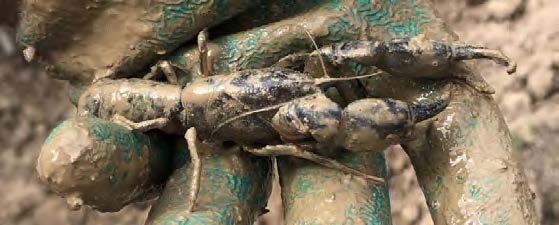

Central North Burrowing Crayfish
Burrowing-crayfish dig extensive tunnels often reaching down to the water table, up to 3m deep. All burrowing-crayfish construct characteristic “chimneys” up to 40cm high made from balls of mud placed around the entrance of the burrows. They feed on decaying organic matter in the soil, sticks, leaves and occasionally other invertebrates they encounter in their burrows. Females carry eggs and newly hatched young under the tail.
The Latrobe flood levee project required works in areas which were inspected in detail and expected to contain the endangered Central North Burrowing Crayfish, Engaeus granulatus (CNBC).
The levee project required referral under the Environmental Protection and Biodiversity Conservation Act 1999 (EPBC Act) and a permit for the levee work and reporting about the species after construction.
Below are the published documents associated with this element of the project:
- Latrobe Levee Project - Offset Management and Monitoring Plan – Central North Burrowing Crayfish
- Latrobe Levee Project – EPBC 2020/8846 - Central North Burrowing Crayfish – Salvage and Translocation Reporting (Offset Monitoring and Compliance Report including 12, 36 and 52 week plus 2 year and 3 year observations and reporting)
- Latrobe Levee Project - Annual Compliance Report - Central North Burrowing Crayfish